Intandid Virtual Workshop Recap: The Coaching Leader
Around 16 senior leaders from China and Japan joined the first online session of The Coaching Leader, a four-part leadership programme led by executive coach Julie Zhang.
The session explored one simple idea: good leaders do not always need to have all the answers. Sometimes, they need to ask better questions.
Participants learned how coaching can help people think for themselves, solve problems and become more confident at work.
From Giving Answers to Asking Questions
When an employee has a problem, a manager may want to solve it immediately. This can save time, but it does not always help the employee learn.
If leaders always give answers, team members may become too dependent on them.
Coaching takes a different approach. Instead of telling people what to do, leaders ask questions that help them find their own solutions.
The goal is not only to solve today’s problem. It is to help people handle future challenges on their own.
Coach the person, not the problem
One idea stood out: “Don’t coach the box, coach the person.”
The box is the problem someone brings to you. A leader can solve that problem for them. But the same person may need help again when a new problem appears. Coaching focuses on helping them find their own way forward.
The group also discussed an important limit. Sometimes a leader needs a quick result. Coaching is not the right approach for every moment. Leaders need to know when to coach and when to use another style.

What Does a Coaching Leader Do?
The group explored three basic steps of coaching:
Help people understand the situation.
Explore possible solutions together.
Agree on what to do next.
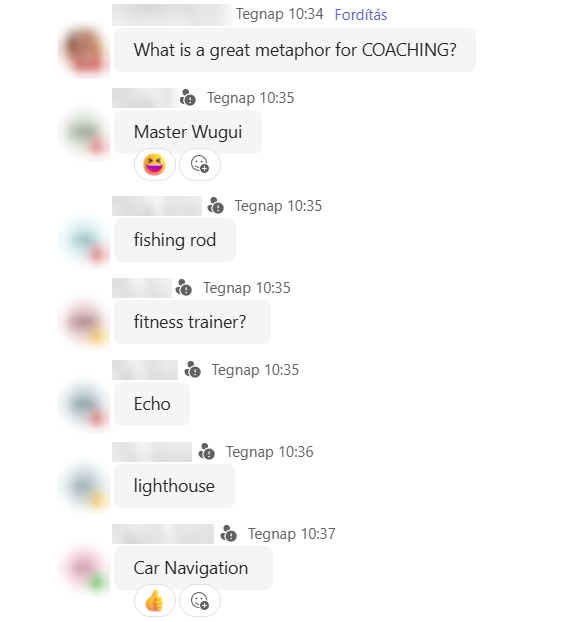
A great metaphor for COACHING: One participant answered Master Wugui from Kung Fu Panda. Rather than simply telling Po what to do, Master Wugui guides him with questions and helps him discover the answer himself.
Different Situations Need Different Leadership Styles
There is no single leadership style that works in every situation.
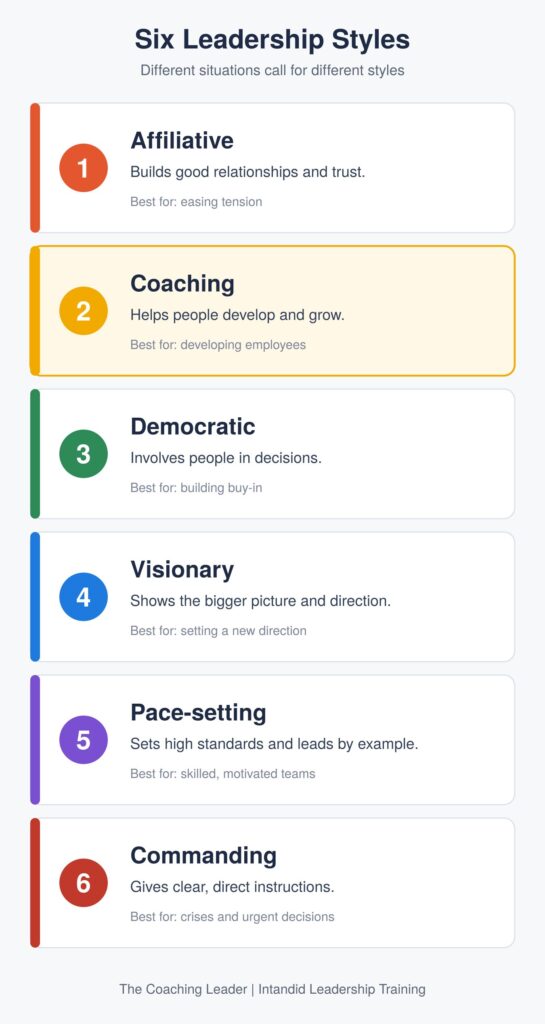
Six leadership styles.
Each style can be useful. For example, during a crisis, clear instructions may be necessary. When developing employees, a coaching approach may be more helpful.
Daniel Goleman‘s idea helped them understand their usual leadership habits and consider when they might need to change their approach.
Listen Before You Respond
Another important topic was listening.
Good coaching starts with giving people your full attention. It is not just about hearing their words. It is also about understanding their feelings and what they are trying to say.
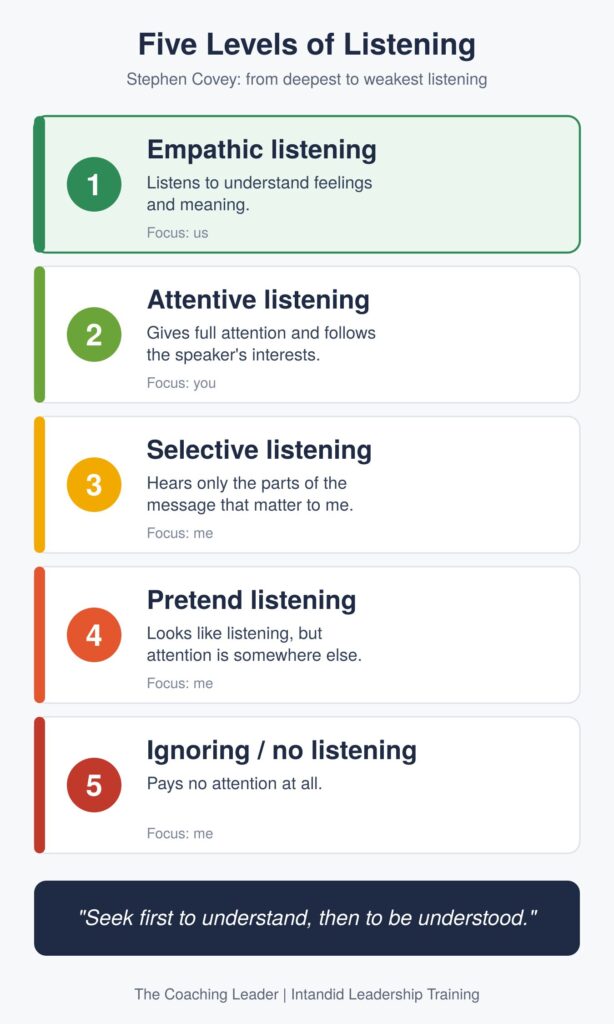
Julie introduced Stephen Covey’s five levels of listening, from ignoring someone to listening with full attention and understanding.
Participants then tried a simple exercise in pairs. One person shared a personal experience while the other listened without interrupting or giving advice.
The exercise showed how easily we can become distracted or start thinking about our own answers instead of listening.
Sometimes, the best response is not an answer. It is simply listening.
Key takeaways and closing reflections
To close the first session of The Coaching Leader, we recapped the main ideas. Good leadership is not about having all the answers. It is about helping others find their own.
The first session highlighted three important coaching skills:
Ask questions instead of always giving instructions.
Listen actively before offering advice.
Encourage ownership and give people space to find solutions.
By practising these skills, leaders can build more confident, independent and capable teams.
Want to know more?
If you’re leading a team and want to help your people become more confident, independent and responsible, this is exactly what we focus on in our Coaching Leadership Training programs.
We help leaders develop practical coaching skills, ask better questions, listen more effectively and create an environment where people can grow and find their own solutions.


Related Articles

Training: The Coaching Leader | From Giving Answers to Asking Questions