Expat talent in China: the bridge your HQ can’t see
If your China team keeps losing arguments with HQ, the problem may not be the argument. It may be that you no longer have the right expat talent in China to translate it.
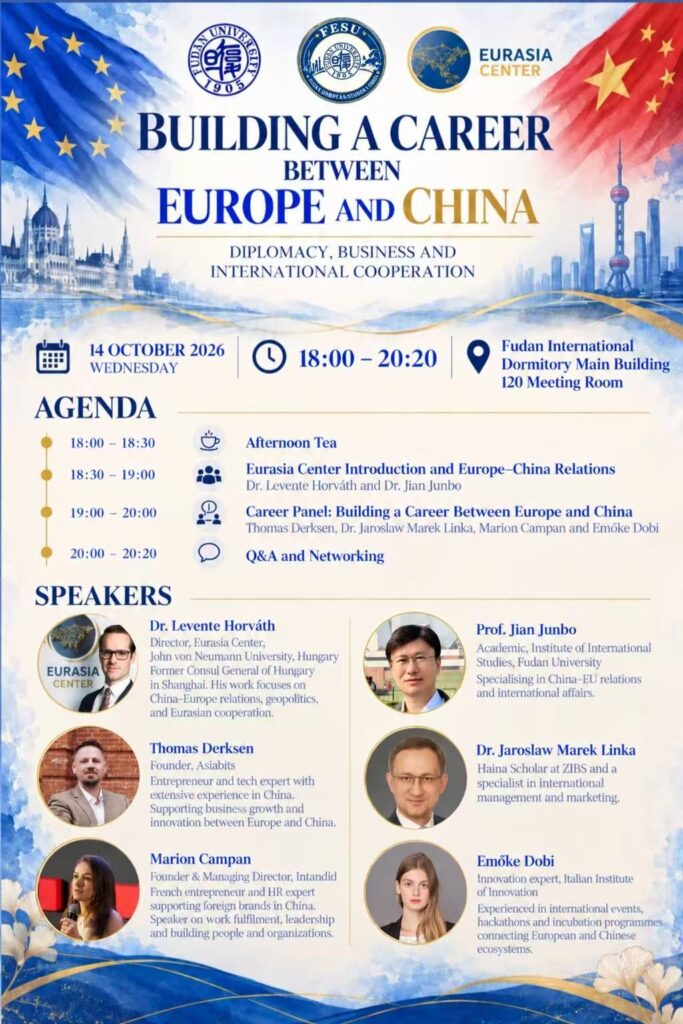
On Wednesday 14 October, I’m joining the career panel “Building a Career Between Europe and China: Diplomacy, Business and International Cooperation” at Fudan University, hosted by the Fudan European Student Union (FESU) and the Eurasia Center. Preparing for it, I kept coming back to a question HR Directors ask me all the time. This article is my answer.
In the HR Director community I moderate, one complaint comes up again and again: “HQ doesn’t listen.” The China HRD flags a risk, explains how a new policy will land with the local team, warns that a decision will cost trust. HQ nods. Then does it their way. Six months later, the turnover numbers arrive and everyone is surprised except the person who called it.
Why your China team keeps losing arguments with HQ
Most HQs don’t ignore China out of arrogance. They ignore it because the message arrives without context they can decode. A local leader says “this will be difficult.” In China, that can mean “this will fail.” At HQ, it often reads as “this will take effort.” Same words, opposite conclusions.
HQ already has dashboards, reports and monthly calls. What’s missing is interpretation, and you can’t send that in a spreadsheet.
What the numbers say HQ is missing
The distance between what HQ believes and what is happening in China is measurable.
In the EU Chamber of Commerce in China’s Business Confidence Survey 2026, 48% of European companies said Chinese competitors in their industry are now more innovative than their European counterparts. Only 24% said the opposite. That is how European executives on the ground see their own market. Ask yourself whether your HQ sees it the same way.
The flow is also reversing. Nearly 80% of Chinese companies operating in the EU plan to increase investment there over the next three years, according to a March 2026 report by the China Chamber of Commerce to the EU. Only 38% of European companies in China said the same about China. Chinese greenfield investment in Europe hit a record of nearly 9 billion euros in 2025, up 51% in a year, nearly tripling in Germany and quadrupling in France.
Your HQ will soon be competing with, partnering with, or selling to Chinese companies in its own home market. The people who understand how those companies think are already on your payroll in Shanghai.

The Bridge Reader: what long-term expat talent in China does that HQ can’t
Someone who has spent many years working in China develops a specific kind of literacy. I call these people Bridge Readers.
A Bridge Reader is an experienced professional, often a long-term expat in China, who can interpret China’s business signals for headquarters and predict how decisions will land locally.
Three capabilities set them apart.
- They read between the lines. They hear what a Chinese partner, employee or regulator means, not only what was said, and can explain it in terms HQ trusts.
- They read the subtleties. They notice the shift in tone in a meeting, the hesitation before a yes, the colleague who stopped speaking up. Small signals that never make it into a report.
- They read ahead. They can predict how a decision will land before it’s announced: which team will disengage, which client will go quiet, which policy will be quietly worked around.
All three come from accumulated context, and that takes years to build. You can’t hire it from HQ, and you can’t replace it with a two-year assignment.
Mandarin helps. Years matter more.
The obvious assumption is that the bridge is language. It isn’t, or at least not only.
Mandarin opens doors and builds trust, and it’s worth learning. But I’ve seen experienced expats with limited Mandarin read a room better than fluent newcomers. What they have is not vocabulary. It’s a decade of watching how decisions actually get made here, and the credibility at HQ to say “trust me on this one.”
When you assess who your bridge profiles are, don’t screen on HSK level. Screen on whether HQ changes its mind after talking to them.
The cost of cutting the wrong people
Here’s the risk. Many companies are localizing management, often for good reasons. And keeping foreign staff in China just got more expensive: since early 2026, Shanghai raised the salary threshold for the Category B work permit salary route from CNY 400,000 to CNY 596,832 a year, a jump of roughly 50%. (source Envoy Global)
That makes long-term expats an easy line to cut. Some of those cuts are right. But when the person who leaves is the one who explained China to HQ, the cost doesn’t show up in the budget. It shows up later, in decisions made without them.
Localization and Bridge Readers aren’t opposites. The strongest China operations I see have both: local leaders running the business, and a few people whose real job, whatever their title, is to make sure HQ understands what those leaders are telling them.

Finding the Bridge Readers you already have
Before your next restructuring or budget round, ask three questions.
- Who does HQ call when they want to understand what’s really going on in China?
- When that person disagrees with HQ, does HQ ever change course?
- If they left tomorrow, who would replace that role? Not the title, the role.
If the answer to the last question is “nobody,” you’ve found someone worth protecting.
HQ will misread China again. When it does, will someone in the room still be able to translate?
Join the conversation at Fudan on 14 October
These are the questions I’ll be bringing to Fudan University this Wednesday, alongside a panel that spans diplomacy, academia, entrepreneurship and innovation.
Event | Building a Career Between Europe and China: Diplomacy, Business and International Cooperation |
Date | Wednesday 14 October 2026 |
Time | 18:00 to 20:20 |
Venue | Fudan International Dormitory Main Building, Meeting Room 120, Shanghai |
Hosts | Fudan European Student Union (FESU) and Eurasia Center, John von Neumann University |
Agenda
- 18:00 Afternoon tea
- 18:30 Eurasia Center introduction and Europe-China relations, with Dr. Levente Horváth and Prof. Jian Junbo
- 19:00 Career panel with Thomas Derksen (Founder, Asiabits), Dr. Jaroslaw Marek Linka (Haina Scholar, ZIBS), Emőke Dobi (Italian Institute of Innovation) and me
- 20:00 Q&A and networking
I’ll share the key takeaways from the students’ questions here after the event.
Usually because messages arrive without the context needed to decode them. Indirect language, like “this will be difficult,” can signal a hard no in China but read as “extra effort needed” at HQ.
For roles that bridge HQ and the local business, often yes. Their value shows up in decisions HQ avoids getting wrong, which rarely appears in a budget line.
Mandarin helps build trust, but years of context in China often matter more for interpreting signals and anticipating reactions.
The salary threshold for the Category B salary route rose from CNY 400,000 to CNY 596,832 a year, roughly 50%. Degree and experience routes still exist.

Related Articles
R.E.D. Learning Day Recap: How to influence headquarters from the region